
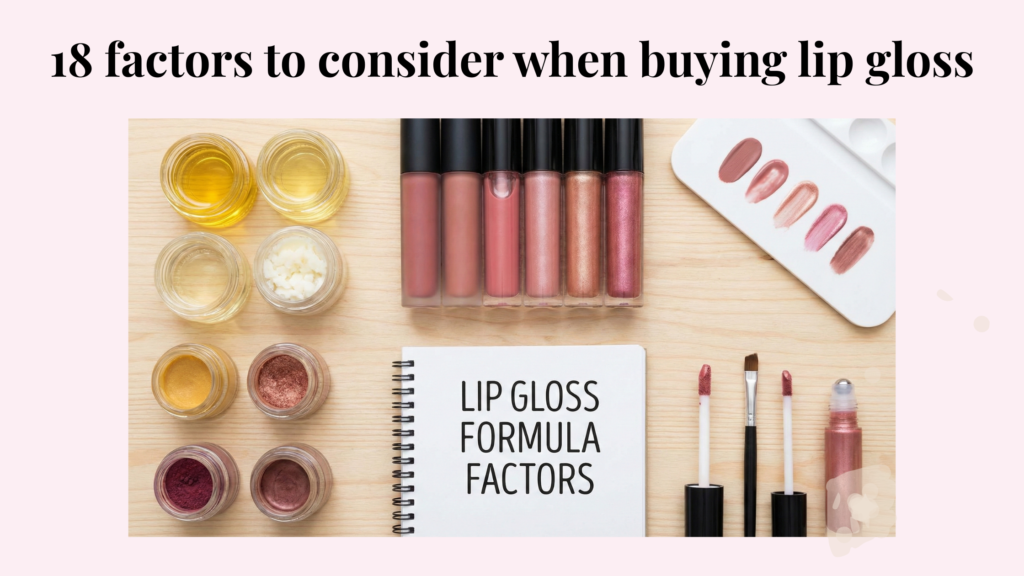
18 Factors to Consider When Buying Lip Gloss: The Ultimate Guide
Finding your “holy grail” product requires evaluating 18 specific lip gloss buying factors, ranging from the physics of polymer adhesion (stickiness) to the safety profile of the pigment load.
The 18 Factors Covered in This Guide:
- Lip Condition
- Lip Type / Volume
- Skin Sensitivity
- Finish & Shine
- Opacity Level
- Color / Pigment
- Shade Variety
- Plumping Effect
- Texture (Stickiness)
- Moisturizing Agents
- Longevity
- Flavor / Scent
- Ingredients Safety
- Ethical Standards
- Product Form
- Applicator Type
- Packaging Quality
- Price / Value
We have evolved past the 2000s era of the “hair-trap”—those thick, glue-like formulas that caught every stray strand of hair in a moderate breeze. Today’s market is sophisticated. It’s a spectrum. But the core trade-off remains: physics dictates that if you want glass-like shine that lasts 4 hours, it will feel sticky. That’s not a flaw; that’s the nature of the sealant. If it feels like water, it will evaporate like water.
The Decision Matrix
This guide is a decision matrix that categorizes factors into Biological Needs (what your skin demands), Aesthetic Finish (the visual result), Formulation Feel (the sensory experience), and Practical Logistics (hardware and cost). It synthesizes 18 essential variables to help you balance the trade-off between longevity and comfort.
This guide categorizes 18 essential factors to help you balance the trade-off between longevity and comfort.
Analyzing Your Lips: Biological Lip Gloss Buying Factors
Your biological canvas dictates the formula requirement, as dry lips demand oil-based protection while sensitive skin must avoid common plumping irritants (1).
Before you look at a color swatch, look at your own face. Sethi et al. (2016) emphasize that damaged skin barriers (chapped lips) require occlusives (waxes/oils) to prevent further TEWL, not just aesthetic coverage (1). Putting a drying alcohol-based plumper on cracked lips isn’t makeup; it’s chemical warfare.
Lip Condition
Are they dry or smooth? Chapped lips need healing oils (Shea, Lanolin). Smooth lips can handle exfoliation and light-reflecting shimmers without looking gritty.
Lip Type/Volume
Thin lips benefit most from high-shine, clear, or light-colored glosses, which create an optical illusion of volume. Full lips can wear highly pigmented crèmes without looking “heavy” (Heuristic Guideline).
Skin Sensitivity
Check for allergens immediately. Menthol, peppermint oil, and cinnamon are common sensitizers found in “plumping” formulas (3). If you have eczema or rosacea, these ingredients can trigger a flare-up that extends beyond the vermilion border.
Defining Visual Finish: Aesthetic Lip Gloss Buying Factors
The aesthetic finish determines the product’s function, ranging from sheer topcoats to opaque liquid lipsticks that replace traditional bullets.
Finish and Shine
This is the “Refractive Index.” Do you want a subtle sheen (office-appropriate), a glass-like finish (high polymer load, very sticky), or a shimmer/glitter finish (festive, but can feel gritty)?
Opacity
Sheer: Acts as a topcoat. Great for layering over liner.
Opaque: A standalone product. Replaces lipstick. Requires precise application because mistakes are visible.
Color/Pigment
Match your undertone. Cool tones (blue-based reds) make teeth look whiter; warm tones (orange-based) suit olive skin.
Shade Variety
Does the brand offer depth? A “nude” is not universal. Look for ranges that cater to pale, medium, and deep complexions.
Plumping Effect
Distinguish between Active Plumping (irritation via capsicum/bee venom) vs. Passive Plumping (hydration/optical illusion) (3).
Evaluating Texture & Wear: Sensory Lip Gloss Buying Factors
Texture and longevity are inversely correlated; high-viscosity (sticky) formulas act as sealants that hold pigment in place significantly longer than low-viscosity (oily) formulas (2).
Lochhead (2014) explains that polymers like Polybutene provide the viscosity required for film formation and long wear, creating the “tacky” feel consumers often dislike but require for longevity (2). It creates a grip. Without that grip, the pigment slides off your lip onto your coffee cup within 20 minutes.
Texture (The Trade-Off)
Decide now: Do you want it to last through lunch (Sticky/Thick)? Or do you want it to feel weightless (Oily/Thin)? You generally cannot have both.
Moisturizing Agents
Look for Vitamin E (Tocopherol), Squalane, and Shea Butter. These ingredients ensure the gloss conditions your lips rather than just sitting on top of them.
Longevity
Gloss wears off faster than matte; tackiness extends this. If a product claims “12-hour wear” and it’s a gloss, be skeptical—it’s likely a liquid lipstick hybrid.
Flavor/Scent
Vanilla and fruity scents are common, but if you lick your lips often, strong flavors promote saliva transfer, which actually dries out your lips (Heuristic Guideline).
Ingredients
Check for parabens if that concerns you. “Clean” beauty standards vary by retailer, so read the INCI list yourself.
Ethics
Look for Vegan (no beeswax/carmine) and Cruelty-Free certifications if these align with your values.
Practical Considerations: Logistical Lip Gloss Buying Factors
The applicator mechanics shape the final result, determining whether the product deposits a sheer wash or a saturated layer of color.
Draelos (2015) outlines how applicator surface area affects pigment deposition density (4). A giant doe-foot holds more product, giving you “one-swipe” coverage but less precision. A tiny brush gives you artistry control but requires multiple dips.
Form
Tube (Wand): Precision. Best for pigmented gloss.
Squeeze Tube: Casual. Best for thick balms/jellies.
Pot: Requires a finger or brush. High contamination risk.
Applicator Type
Doe-foot: The standard sponge tip. Good for coverage.
Rollerball: Retro. Deposits a thin, wet layer. Nostalgic but messy.
Brush: Rare. Great for precise lining but can get splayed.
Packaging
Check the seal. Squeeze tubes with screw tops are the most leak-proof. Click-pens are notorious for leaking in hot cars.
Price/Value
Calculate cost per mL. Luxury glosses often have heavy glass components that mask a small amount of product.
Summary Table & Checklist for Lip Gloss Buying Factors
This decision matrix synthesizes the 18 factors to help you select a product based on your primary goal (Comfort, Longevity, or Precision).
| Factor Category | If You Want Longevity… | If You Want Comfort… | If You Have Dry Lips… |
|---|---|---|---|
| Texture | High Tack (Sticky) | Oil-Based (Slippery) | Thick/Occlusive |
| Ingredients | High Polymer Count | Botanical Oils | Vitamin E / Ceramides |
| Applicator | Doe-Foot (Deposit) | Rollerball/Brush | Squeeze Tube (Heavy) |
| Avoid | High Oil Content | High Wax Content | Plumping Agents (Menthol) |
Key Takeaways: The Savvy Shopper’s Checklist
- Biology Dictates Formula: Analyze your lip condition first. Chapped lips need oils and Vitamin E, not drying plumping agents (1).
- The Physics of Stickiness: Accept the trade-off. If you want 4+ hours of wear, you must accept high-polymer tackiness (2).
- Hardware Matters: The applicator isn’t just a handle; it controls pigment load. Use a doe-foot for color and a brush for precision.
- Safety First: If you have sensitive skin, avoid “active” plumpers with menthol or capsicum to prevent contact dermatitis (3).
Frequently Asked Questions
Why is my lip gloss so sticky?
Stickiness is usually due to high molecular weight polymers like Polybutene. This isn’t a defect; it’s a functional feature that acts as a sealant to keep the gloss on your lips longer. Without this “tack,” the product would slide off quickly.
Can lip gloss dry out my lips?
Yes, if it contains humectants (like glycerin) without occlusives (like oils/waxes), or irritants like menthol. This can cause “Rebound Dryness,” where moisture is pulled from your lips and evaporates. Look for Vitamin E and botanical oils to prevent this.
What is the difference between lip gloss and lip oil?
Lip oils are primarily composed of penetrating oils (like Jojoba or Rosehip) for hydration with a sheer shine. Lip glosses use polymers to sit on top of the skin for high shine and longer wear. Gloss protects; oil treats.
Is plumping lip gloss bad for you?
Most “active” plumpers use mild irritants like capsicum (pepper) or peppermint to swell the lips via inflammation. While generally safe for occasional use, chronic use can lead to contact dermatitis or long-term dryness, especially on sensitive skin.
Final Thoughts on Mastering Lip Gloss Buying Factors
The perfect gloss is a balance of biology and lifestyle, requiring you to weigh the importance of “stickiness” against the need for frequent reapplication.
Pro-Tip: When in doubt, start with texture. A comfortable feel ensures you’ll actually wear the product, regardless of how pretty the color looks in the tube.
Reference List
- Sethi A, et al. Moisturizers: The Slippery Road. Indian J Dermatol. 2016;61(3):279-287. Available from: https://pubmed.ncbi.nlm.nih.gov/27293248/
- Lochhead RY. The Role of Polymers in Cosmetic Formulations. In: Handbook of Cosmetic Science and Technology. 4th ed. CRC Press; 2014.
- American Academy of Dermatology (AAD). Contact Dermatitis: Triggers and Prevention. Available from: https://www.aad.org/public/diseases/eczema/types/contact-dermatitis
- Draelos ZD. Cosmetic Dermatology: Products and Procedures. 2nd ed. Wiley-Blackwell; 2015.
One Response