
Why Product Form Matters in Selecting Lip Gloss: Formula, Function & Hygiene
Most buyers choose a gloss based on color, ignoring the vessel it comes in; however, the lip gloss product form—whether it’s a pot, a squeeze tube, or a wand—actually dictates the viscosity, shelf-life, and performance of the formula inside (1).
It’s not just a bottle. It’s an engineering constraint. You simply cannot put a thick, butter-based mask into a wand component—it won’t flow. Conversely, you can’t put a liquid stain in a pot—it will spill. The vessel dictates the cargo.
The 3 Core Forms
- 1. The Pot (Solid): Best for repair. Holds dense waxes and butters. High hygiene risk.
- 2. The Squeeze Tube (Gel): Best for hygiene. Dispenses cushiony gels without air exposure. Low precision.
- 3. The Wand (Liquid): Best for precision. Required for painting color. Moderate hygiene risk due to “pumping.”
This guide analyzes how the physics of the container determines the chemistry of the gloss, helping you predict stickiness and hydration before you buy.
Quick Guide to Lip Gloss Product Forms
Each of the major lip gloss forms serves a distinct functional purpose, optimizing for either maximum repair, maximum hygiene, or maximum precision.
The Pot (Jar) – The Heavyweight Hydrator
The pot is the only vessel capable of holding solid-phase ingredients like high-melting-point waxes and dense butters that are too viscous to flow through a nozzle (1).
These formulas are essentially “sleeping” at room temperature. They rely on the heat of your finger (approx. 32°C – 35°C) to melt the crystalline structure of the wax so it can be spread. Sethi et al. (2016) classify occlusives (petrolatum, lanolin, waxes) as the most effective agents for reducing TEWL, noting their typically semi-solid state (2). If you need serious barrier repair, you need a pot.
- Pro: Highest concentration of Occlusives. It’s a “blanket” for your lips.
- Con: The “Double-Dip” hygiene risk. Every time you dip your finger, you introduce skin microflora (Staphylococcus) and dust into the product. It is an open petri dish.
The Squeeze Tube – The Hygienic Hybrid
Squeeze tubes are engineered for high-viscosity gels that are too thick for a wand to lift but soft enough to flow under pressure.
This is where “Shear Thinning” comes in. The formula sits thick in the tube, but when you squeeze (applying shear stress), the viscosity drops, allowing it to flow. Draelos (2015) outlines how tube packaging protects formulas from oxidation and contamination compared to open jars, supporting the “hygiene” claim (3). It keeps the air out and the moisture in.
- Pro: Airtight system. If you apply it directly to your lips, wipe the tip, and cap it, it remains virtually sterile.
- Con: Zero precision. The slanted tip deposits a “blob” or a “glaze.” You cannot define the Cupid’s bow with a squeeze tube.
The Wand (Hard Tube) – Precision and Pigment
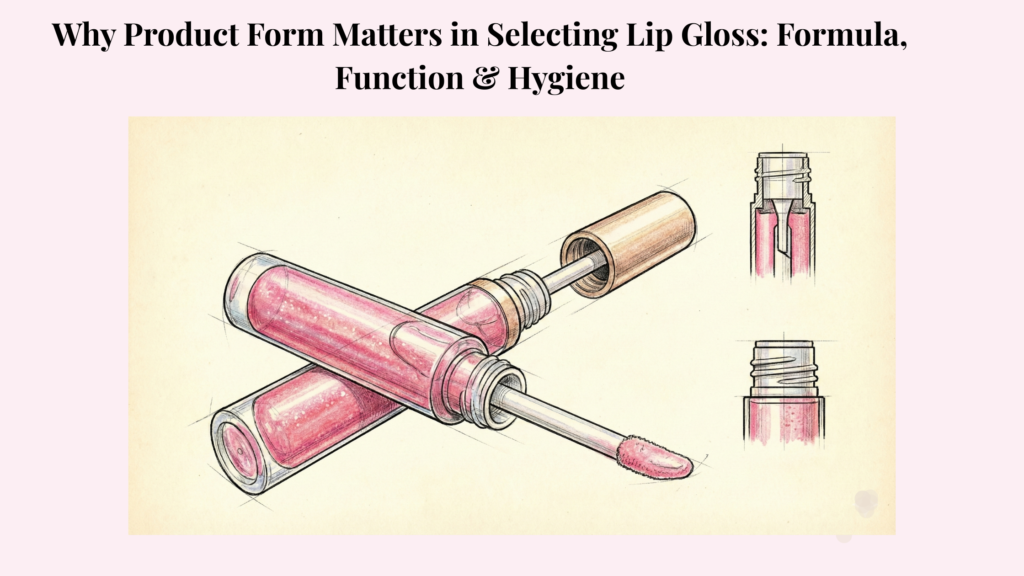
Wand components require liquid-to-creamy formulas because the applicator must physically lift the product out of the reservoir without it sliding off (1).
But there is a hidden cost to this precision: The Pumping Effect. Every time you push the wand back into the tube, you are acting like a bicycle pump, forcing air—and whatever bacteria was on your lips—deep into the formula.
Bashir & Lambert (2019) found that 70–90% of used lip products (specifically those with wand applicators) contained significant bacterial contamination (e.g., Staphylococcus, E. coli) due to this pumping mechanism (4).
- Pro: High precision. Doe-foot applicators allow for outlining the Cupid’s bow and depositing heavy pigment loads (3).
- Con: Shortest shelf-life. Once opened, the timer starts ticking faster than any other form.
Comparing Lip Gloss Product Forms: Which Fits Your Lifestyle?
Selecting the right form is a trade-off between the level of repair you need and the level of hygiene you can maintain.
| Feature | The Pot (Jar) | The Squeeze Tube | The Wand (Hard Tube) |
|---|---|---|---|
| Formula Thickness | Solid / Balm-like | Thick Gel | Liquid / Cream |
| Primary Benefit | Deep Repair | Hygiene & Volume | Precision & Color |
| Hygiene Risk | High (Finger Contact) | Low (Sealed System) | Medium (Air Pumping) |
| Best Use Case | Nightstand / Bedtime | Gym Bag / Commute | Date Night / Events |
Final Thoughts on Selecting the Right Lip Gloss Product Form
Don’t just look at the swatch; look at the container, because the packaging tells you more about the formula’s texture and purpose than the color does.
Pro-Tip: Keep pots at home for clean hands (nightstand), and stick to wands or tubes for your purse to minimize bacterial contamination while on the go (Heuristic Guideline).
Reference List
- Lochhead RY. The Role of Polymers in Cosmetic Formulations. In: Handbook of Cosmetic Science and Technology. 4th ed. CRC Press; 2014.
- Sethi A, et al. Moisturizers: The Slippery Road. Indian J Dermatol. 2016;61(3):279-287. Available from: https://pubmed.ncbi.nlm.nih.gov/27293248/
- Draelos ZD. Cosmetic Dermatology: Products and Procedures. 2nd ed. Wiley-Blackwell; 2015.
- Bashir A, Lambert P. Microbiological study of used cosmetic products: highlighting the need for preservative efficacy testing. J Appl Microbiol. 2020;128(2):598-605. Available from: https://pubmed.ncbi.nlm.nih.gov/31588613/
One Response