
Why Finish and Shine Level Matter in Lip Gloss Results: Optical Illusions & Texture
Most people buy lip gloss for the shade, but the finish and shine level determines the final structure of your look by manipulating how light interacts with the lip surface (1).
It’s not magic. It’s optics. The way a gloss reflects light—whether it’s a mirror-like glass finish or a diffused pearl shimmer—creates optical illusions that can maximize volume, blur vertical lines, or highlight texture. But be warned: Glass skin requires thick, sticky polymers. There is no way around the physics.
The 3 Core Finishes
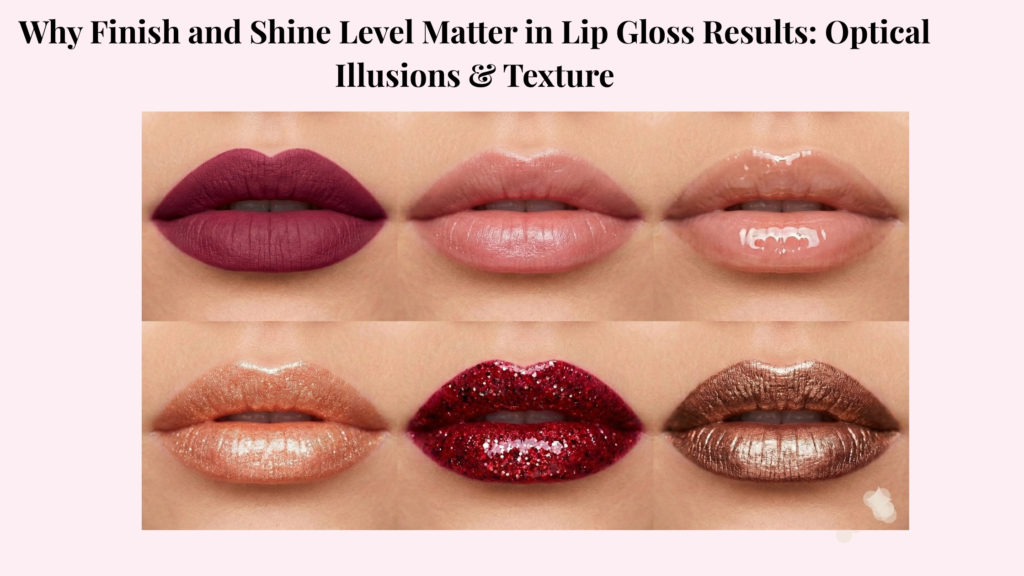
- 1. High-Shine (Glass): Best for Volume. Reflects light directly to creating a projected, 3D effect. High tack.
- 2. Shimmer (Pearl): Best for Camouflage. Scatters light to blur texture and hide vertical lines. Variable texture.
- 3. Cream (Satin): Best for Comfort. Absorbs light for a natural, moisturized look. Low tack.
This guide breaks down the physics of light reflection to help you use finish and shine level as an architectural tool for your lips.
Quick Guide to Lip Gloss Finish and Shine Levels
Broadly speaking, there are 3 types of lip gloss finish, and each serves a distinct optical function, optimizing for either maximum volume, texture camouflage, or natural enhancement.
High-Shine Levels: Using the “Glass Effect” for Maximum Volume
High-shine finishes create the illusion of volume through specular reflection, where light bounces directly back to the eye without scattering (2).
Draelos (2015) explains that high-viscosity oils (like polybutene) create a smooth film with a high refractive index, mimicking the behavior of a mirror (3). This smooth surface erases depth cues—like shadows in lip cracks—making the surface appear “projected” forward. It catches the light beam and throws it back.
Heuristic Guideline: A clear high-shine gloss makes lips look larger than a pigmented one because transparency adds depth to the reflection.
Trade-Off: To maintain surface tension (that “smooth dome” of gloss), these formulas must be thicker or tackier. If it isn’t sticky, the dome collapses, and the shine fades.
Shimmer Finishes: Diffusing Light to Hide Texture
Shimmer finishes utilize “diffuse scattering” to camouflage texture, bouncing light in multiple directions rather than a straight line (2).
Lochhead (2017) notes that particle additives (like mica or borosilicate) interrupt the smooth film, creating a multi-faceted reflection that breaks up visual continuity (1). This creates a “soft-focus” effect. By scattering light, you prevent deep shadows from forming in vertical lip lines. The sparkle distracts the eye from the cracks.
Best For: Lips with deep vertical lines or dry texture.
Trade-Off: Can feel gritty if the particles are too large (>150 microns) (Heuristic Guideline).
Low-Shine Levels: The Cream Finish for Natural Enhancement
Cream finishes absorb more light than they reflect, mimicking the natural moisture level of healthy skin rather than creating an artificial layer.
These formulas have a lower refractive index and often contain more waxes/butters, creating a satin finish that integrates with the lip tissue. They are the “Your Lips But Better” choice for professional settings or “No-Makeup” makeup looks where overt shine is distracting.
Trade-Off: Zero plumping effect; the size of your lips remains visually unchanged because there is no optical projection.
Choosing the Right Finish and Shine Level for Your Goal
Selecting the right finish requires matching the optical effect to your specific aesthetic goal (Volume vs. Camouflage vs. Comfort).
| Finish Type | Light Physics | Visual Effect | Texture Feel | Best For |
|---|---|---|---|---|
| High-Shine (Glass) | Direct Reflection | Max Volume | Tacky / Thick | Thin Lips |
| Shimmer (Pearl) | Diffused Scattering | Blurring Lines | Smooth / Gritty | Textured / Aging Lips |
| Cream (Satin) | Low Reflection | Natural Hydration | Soft / Balmy | Office / Daily Wear |
Frequently Asked Questions
Which lip gloss finish makes lips look biggest?
High-shine (Glass) finishes. The direct “specular” reflection creates a projection effect that tricks the eye into seeing more volume than actually exists.
Why does my shimmer gloss feel gritty?
Grit occurs when the light-reflecting particles (like mica or borosilicate) are larger than 150 microns. For a smooth feel, look for formulas labeled “micro-fine” or “pearl.”
What is the best finish for textured or aging lips?
Shimmer (Pearl). Unlike glass finishes which can highlight imperfections, or matte creams which settle into lines, the diffused light scattering of shimmer blurs vertical lines and texture.
Conclusion
Color provides the mood, but the finish and shine level provides the architecture of your lip look.
Pro-Tip: For the ultimate pout, layer a Shimmer gloss in the center of the lip (to catch light) over a Cream lipstick. This creates a 3D contour effect (Heuristic Guideline).
Reference List
- Lochhead RY. The Role of Polymers in Cosmetic Formulations. In: Handbook of Cosmetic Science and Technology. 4th ed. CRC Press; 2014. Available from: https://www.taylorfrancis.com/books/edit/10.1201/b16716/
- Katz, L.C., et al. Optical Properties of Surfaces. In: Principles of Optics. Cambridge University Press.
- Draelos ZD. Cosmetic Dermatology: Products and Procedures. 2nd ed. Wiley-Blackwell; 2015. Available from: https://onlinelibrary.wiley.com/doi/book/10.1002/9781118655566