
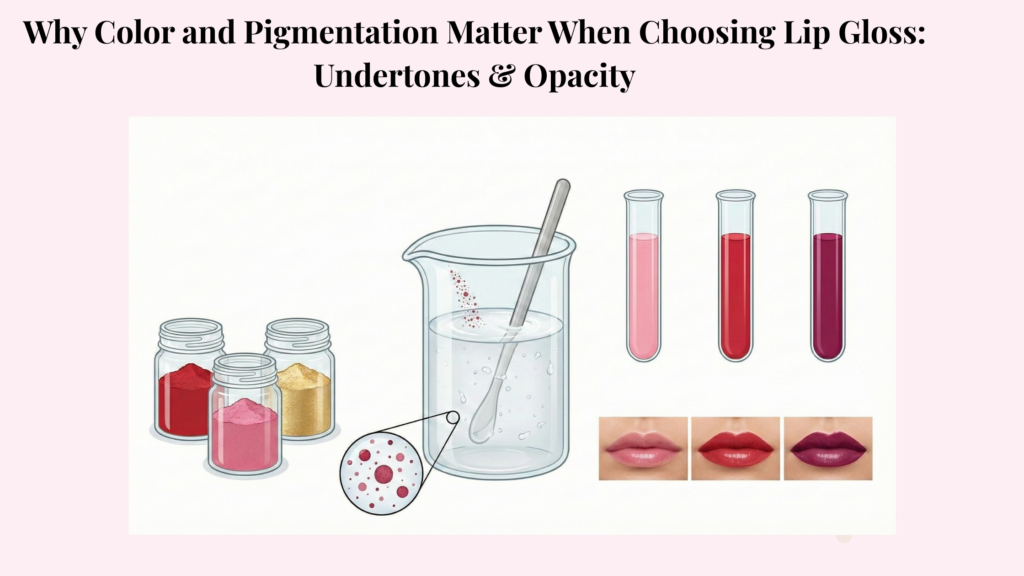
Why Color and Pigmentation Matter When Choosing Lip Gloss: Undertones & Opacity
Choosing the right gloss isn’t just about picking a pretty shade; it requires understanding pigment load (sheer vs. opaque) and undertone theory to ensure the product compliments your skin rather than clashing with it (1).
We’ve all been there: you see a stunning berry shade in the tube, buy it, and realize it applies as a clear slime on your face. This common frustration happens when buyers ignore the mechanics of lip gloss pigmentation. It looks red in the bottle. It looks clear on your face. Why? The answer lies in the physics of opacity.
The 3 Variables of Color
- 1. Pigment Load: The intensity or density of color particles (Sheer wash vs. Opaque paint).
- 2. Undertone: The temperature of the shade (Cool/Blue vs. Warm/Orange).
- 3. Canvas Interaction: How your natural lip color alters the final result.
This guide breaks down opacity levels, skin tone harmony, and the science of color interaction to help you stop wasting money on invisible glosses.
Quick Guide to Lip Gloss Color and Pigmentation Levels
Understanding the three pillars of gloss color—opacity, temperature, and depth—allows you to predict how a product will actually look on your face.
Pigment Levels
Sheer: Best for layering. Adds tint without hiding natural lip color.
Opaque: Best for statement looks. Provides lipstick-level coverage.
Undertone Goals
Cool (Blue-Based): Best for whitening teeth.
Warm (Orange-Based): Best for brightening golden complexions.
Defining Pigmentation: How Coverage Affects Lip Gloss Color
Pigmentation refers to the density of color particles suspended in the formula, which determines whether the gloss functions as a transparent filter or an opaque covering (2).
Draelos (2011) classifies cosmetic coverage based on pigment concentration percentages, distinguishing between glazes (<5% pigment) and lacquers (>15% pigment) (2). Think of it as the difference between a watercolor wash and oil paint.
- Sheer/Translucent: Low pigment load. Relies on the user’s natural lip color as a base. Best for “No-Makeup” looks.
- Semi-Opaque (Milky): Medium pigment load. Blurs natural lip lines but doesn’t fully block natural color. Best for soft, romantic looks.
- Full Coverage (Lacquer): High pigment load. Completely blocks out the natural lip color. Best for replacing liquid lipstick or correcting uneven lip pigmentation.
Key Takeaway: If you have naturally dark or two-toned lips, you need high pigmentation to see the true color; sheer formulas will only add shine.
Matching Lip Gloss Color and Pigmentation to Your Undertone
The “prettiest” color in the bottle is irrelevant if it clashes with your skin’s underlying temperature (undertone) (1).
Bernstein (2008) details how skin melanin and vascularity (your undertones) interact with applied cosmetic pigments to create the final perceived color (1). It’s basic color theory: cool tones clash with warm tones unless deliberately contrasted.
Cool Undertones
Select: Berry, Mauve, and Blue-Red glosses.
Avoid: Orange-heavy corals which can make skin look sallow/yellow.
Insight: Blue-based glosses make teeth appear whiter by canceling out yellow enamel tones (Heuristic Guideline).
Warm Undertones
Select: Peach, Coral, Gold-shimmer, and Brick Red glosses.
Avoid: Icy silvers or harsh magentas which can look gray or “ashy” on golden skin.
How Chemistry Alters Lip Gloss Color and Pigmentation
The final color is a chemical interaction, not just a surface application, as your natural lip pH and base color actively change the result.
The “Tube vs. Lip” Reality: Because gloss is translucent, your natural lip melanin is the “final ingredient.” A pale pink gloss on dark lips may appear gray or invisible due to low opacity. You aren’t painting on a blank canvas; you are glazing over a colored one.
pH Reactants (Color-Changing): Many “mood” glosses use Red 27 (CI 45410). This dye is colorless in the tube but turns bright pink upon contact with moisture/pH (3). While fun, the result is often a chemically uniform bright pink, regardless of the “custom” claim.
Choosing the Right Lip Gloss Color and Pigmentation Strategy
This decision matrix helps you select the right pigment load and undertone based on your specific cosmetic goal.
| Goal | Required Pigment Load | Recommended Undertone |
|---|---|---|
| Whitening Teeth | Medium to High (Opaque) | Cool (Blue-Based) |
| Natural / Office | Sheer to Medium | Your Lips But Better (Neutral) |
| Evening / Photo | High (Full Coverage) | High Contrast (Deep Berry/Red) |
| Topping Lipstick | Sheer (Translucent) | Complimentary (Gold over Red) |
Frequently Asked Questions
Why does lip gloss look different on my lips than in the tube?
Lip gloss is translucent, meaning your natural lip color shines through and alters the final shade. Your lip melanin acts as a “base coat” that changes the result.
Which lip gloss makes teeth look whiter?
Cool-toned glosses with blue undertones (like berry, plum, or cool pink) neutralize yellow tones in enamel, creating an optical whitening effect.
What is the difference between sheer and opaque lip gloss?
Sheer gloss has a low pigment load (<5%) and acts as a tint/filter. Opaque gloss has a high pigment load (>15%) and provides full coverage similar to a liquid lipstick.
Conclusion
Don’t let the tube deceive you; true mastery of lip gloss involves understanding how opacity and undertone interact with your unique biology.
Pro-Tip: If you bought a gloss with the wrong undertone, layer it over a lip liner in a corrective shade to neutralize the clash (Heuristic Guideline).
Reference List
- Bernstein EF. The art and science of color in cosmetics. Clin Dermatol. 2008;26(1):4-9. Available from: https://pubmed.ncbi.nlm.nih.gov/18280902/
- Draelos ZD. Cosmetic Dermatology: Products and Procedures. 1st ed. Wiley-Blackwell; 2011.
- FDA. Summary of Color Additives for Use in the United States in Foods, Drugs, Cosmetics, and Medical Devices. Available from: https://www.fda.gov/