
Why Texture and Feel Matter in Lip Gloss Comfort: The Sticky vs. Smooth Debate
Texture is not just about comfort; it is a functional indicator, as the lip gloss texture and feel dictates exactly how long the product will last and how well it will hydrate (1).
We have all experienced the “wind tunnel nightmare”—hair getting hopelessly stuck in a fresh coat of lip gloss. It feels gross. It feels suffocating. But that “ick” factor is actually physics at work. It’s not just you; it’s rheology.
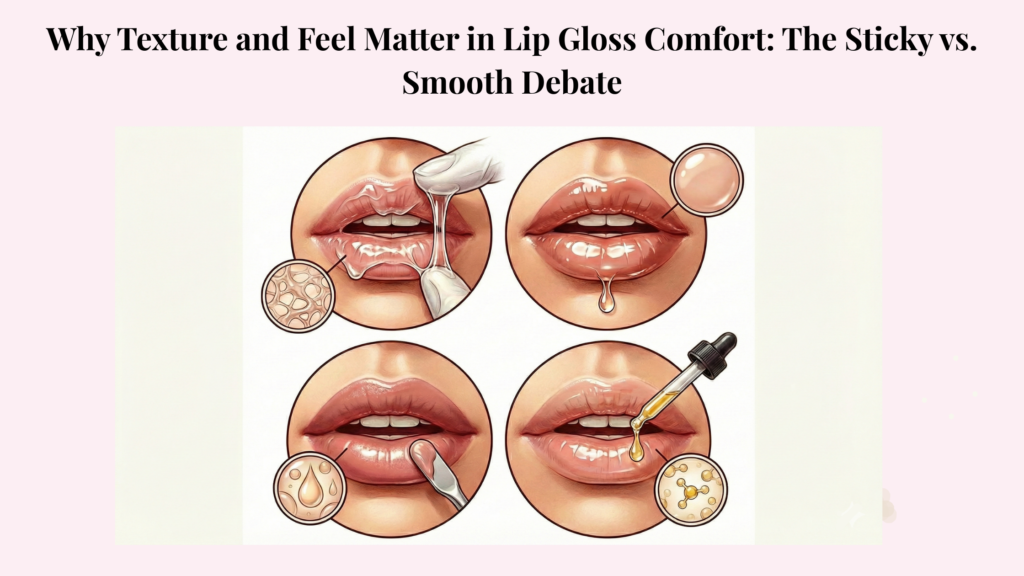
The 3 Texture Categories
- 1. The Tacky (Sticky): High Adhesion. Acts as “The Glue” for long wear.
- 2. The Slippery (Oily): High Lubricity. Acts as “The Oil Slick” for comfort and speed.
- 3. The Cushiony (Creamy): High Viscosity/Low Tack. Acts as “The Spackle” for barrier repair.
This guide breaks down the physics of adhesion and lubricity to help you choose a texture that matches your tolerance and lifestyle.
Quick Guide to Lip Gloss Texture and Feel Categories
Understanding the three primary texture profiles allows you to predict performance before you even apply the product.
The Role of Tackiness: Why Sticky Lip Gloss Texture Lasts Longer
Tackiness is a form of adhesion, created by high-viscosity polymers that form a physical bond with the lip skin to resist migration (2).
Draelos (2015) explains that high-molecular-weight polymers (like Polybutene) provide the substantivity (staying power) required for long-wear cosmetics (2). Think of it as “The Glue.” Sticky means the product has high cohesion (it sticks to itself) and high adhesion (it sticks to you). This prevents feathering into fine lines. It sticks. It drags. But it stays.
Best For: Long events, windy days (ironically, because it stays put), or topping lipstick.
Trade-Off: The “Hair Trap” factor. You will feel it sitting there.
The Role of Slip: Why Oil-Based Lip Gloss Texture Maximizes Comfort
High-slip textures rely on emollients with high lubricity, reducing friction between the lips to create a “wet” feel rather than a “glue” feel (3).
Sethi et al. (2016) describe how emollients (Jojoba, Squalane) function by filling crevices and providing lubricity, which improves comfort but lacks the film-forming strength of polymers (3). These formulas are “The Oil Slick.” They feel weightless and glide effortlessly.
Best For: Sensory-sensitive users, “Clean Girl” aesthetics, and quick hydration.
Trade-Off: Zero staying power. It slides off while talking or eating because it lacks adhesion.
The Hybrid: Creamy Lip Gloss Texture for Barrier Repair
Cushiony textures utilize waxes to create a buffer, providing the weight of a balm with the finish of a gloss.
Often labeled as “Lip Lacquers,” these have body (substance) without the snap of a sticky gloss. They act as “Spackle” to fill in lip lines. This texture is critical if you are dealing with the issues highlighted in our Product Form Guide, where viscosity dictates repair potential.
Best For: Chronically dry or chapped lips. The thickness physically covers texture.
Trade-Off: Can feel “heavy” or suffocating if applied too thickly (Heuristic Guideline).
Choosing the Right Lip Gloss Texture and Feel for Your Day
Selecting the right texture is a negotiation between your tolerance for sensation and your need for performance. This aligns with the sensory criteria in our 18 Factors Buying Guide.
| Texture Type | Sensory Experience | Longevity | Best Scenario |
|---|---|---|---|
| Sticky (Tacky) | “Glue-like,” Grip | High (3-4 hrs) | Windy days, Events |
| Slippery (Oily) | “Wet,” Weightless | Low (30 mins) | Desk work, Self-care |
| Cushiony (Creamy) | “Balmy,” Thick | Medium (1-2 hrs) | Winter, Chapped Lips |
Frequently Asked Questions
Why is my lip gloss so sticky?
Stickiness comes from high-molecular-weight polymers (like Polybutene) designed to create adhesion. This “grip” is essential for long wear; without it, the product would slide off immediately.
Which texture is best for dry lips?
Cushiony (Creamy) textures are best. They use waxes and butters to form a physical barrier that traps moisture, unlike thin oils which can evaporate quickly or sticky glosses which seal but don’t actively repair.
Why does my lip oil disappear so fast?
Lip oils have high lubricity (slip) but low adhesion. Because they lack the sticky polymers to anchor them to the lip skin, they migrate easily when you talk, eat, or drink.
Final Thoughts on Prioritizing Lip Gloss Texture and Feel
The “best” gloss is subjective, but understanding the physics of texture allows you to stop buying products that irritate your sensory limits.
Pro-Tip: The Finger Snap Test
Test texture on your fingertips. Press your thumb and index finger together; if they snap apart (hear a sound/feel resistance), it’s sticky (adhesive). If they slide silently, it’s oily (lubricious) (Heuristic Guideline).
Reference List
- Lochhead RY. The Role of Polymers in Cosmetic Formulations. In: Handbook of Cosmetic Science and Technology. 4th ed. CRC Press; 2014. Available from: https://www.taylorfrancis.com/books/mono/10.1201/b16716/
- Draelos ZD. Cosmetic Dermatology: Products and Procedures. 2nd ed. Wiley-Blackwell; 2015. Available from: https://onlinelibrary.wiley.com/doi/book/10.1002/9781119036517
- Sethi A, et al. Moisturizers: The Slippery Road. Indian J Dermatol. 2016;61(3):279-287. Available from: https://pubmed.ncbi.nlm.nih.gov/27293248/
One Response