
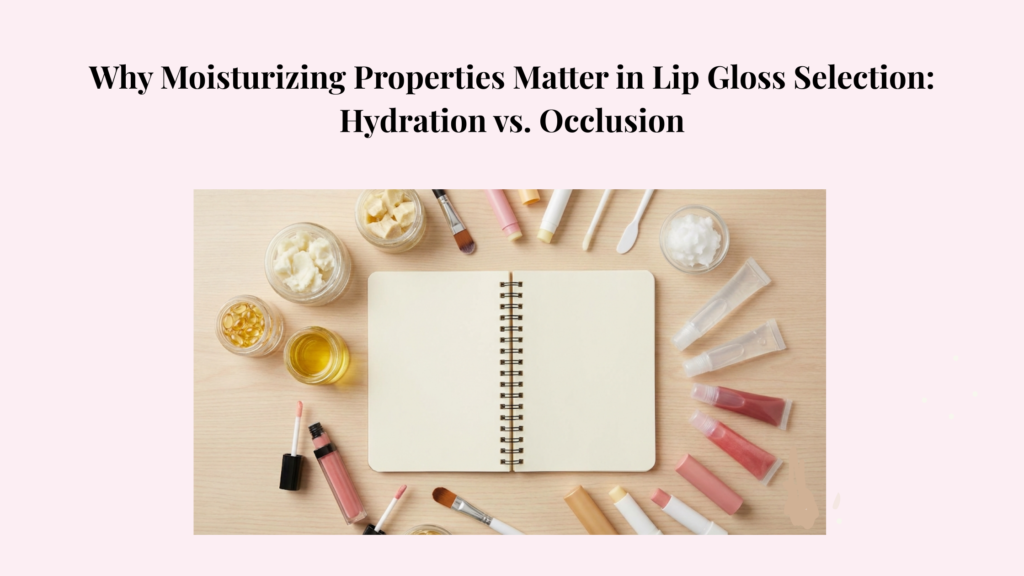
Why Moisturizing Properties Matter in Lip Gloss Selection: Hydration vs. Occlusion
Lips are unique because they lack sebaceous (oil) glands, meaning lip gloss moisturizing properties are not a luxury but a biological necessity to prevent rapid dehydration (1).
Lips are the only skin on your face that cannot hydrate itself. No oil glands. No sweat glands. No defense. When you apply a drying product, you aren’t just uncomfortable; you are exposing raw mucosal tissue to the elements. It burns. It peels. It ruins the look. This guide explains the chemistry of hydration to help you spot a formula that heals rather than harms.
The 3 Pillars of Moisture
- 1. Humectants (The Magnet): Ingredients like Hyaluronic Acid that draw water into the skin.
- 2. Emollients (The Smoother): Oils like Jojoba that fill in cracks and soften flakes.
- 3. Occlusives (The Seal): Waxes and Butters that lock moisture in to prevent evaporation.
A gloss should not just sit on top of the skin; it must actively prevent Trans-Epidermal Water Loss (TEWL).
Quick Guide to Lip Gloss Moisturizing Ingredients
Effective lip hydration requires a synergy of three distinct ingredient categories, each performing a specific mechanical function.
- Humectants (The Magnets): Hyaluronic Acid, Glycerin. Best for drawing moisture in.
- Emollients (The Smoothers): Jojoba Oil, Squalane. Best for softening flakes.
- Occlusives (The Seals): Beeswax, Lanolin, Shea Butter. Best for locking moisture in.
Understanding Why Lip Gloss Moisturizing Properties are Critical
Biological dehydration occurs faster on the lips than anywhere else because they lack the protective lipid layer found on the rest of the face (1).
Piccinin et al. (2023) confirm that the thin stratum corneum creates a high-permeability barrier, leading to TEWL rates 10x higher than facial skin (1). This is why you need help. A non-moisturizing gloss (like old-school alcohol-based plumpers) accelerates this evaporation, acting like a solvent on an already weak barrier.
Key Takeaway: If a gloss doesn’t explicitly list moisturizing properties, assume it is purely cosmetic and pair it with a balm.
Analyzing Active Lip Gloss Moisturizing Ingredients
A balanced formula must contain Humectants, Emollients, and Occlusives to effectively treat the lip tissue while wearing it (2).
Sethi et al. (2016) detail the mechanism of moisturizers, noting that humectants attract water while occlusives are required to prevent that water from evaporating immediately (2).
Heuristic Guideline: Sticky glosses are often the most moisturizing. That tackiness usually comes from occlusives (like Lanolin or Polybutene) that physically prevent water from escaping. If it feels thick, it’s likely working.
Lip Oils vs. Balms: Evaluating Hybrid Moisturizing Properties
Hybrid formulations blur the line between makeup and skincare, offering different ratios of oils to waxes depending on the severity of dryness.
- Lip Oils: High in Emollients. Excellent for immediate relief of tightness, but low staying power (low occlusion).
- Liquid Balms: High in Occlusives. Thicker, mask-like consistency that heals overnight.
- Standard Gloss: Traditionally low in moisture, but modern “clean” formulas now mimic lip oils.
Choosing Lip Gloss Moisturizing Properties by Skin Condition
Selecting the right moisturizer requires diagnosing your specific lip condition, whether it is surface flaking or deep dehydration.
| Lip Condition | Required Property | Key Ingredients to Hunt |
|---|---|---|
| Cracked / Peeling | Repair (Emollient) | Vitamin E, Almond Oil, Ceramides |
| Thirsty / Tight | Hydration (Humectant) | Hyaluronic Acid, Glycerin, Aloe |
| Windburned / Raw | Protection (Occlusive) | Lanolin, Beeswax, Shea Butter |
Frequently Asked Questions
Does lip gloss dry out lips?
It can. If a gloss contains humectants (like glycerin) but lacks occlusives (like oil/wax), it can pull moisture from your lips into the dry air, accelerating dehydration. This is common in “plumping” formulas.
What ingredients are best for cracked lips?
For cracked lips, you need heavy occlusives to seal the tissue. Look for Lanolin, Beeswax, or Shea Butter. Oils alone may not be enough to prevent evaporation.
Is lip oil better than lip gloss for dry lips?
Lip oils offer immediate relief via emollients and feel lighter, but thick, sticky lip glosses (or liquid balms) often provide better long-term protection because they form a stronger seal against the air.
Conclusion
A pretty color looks terrible on cracked lips, making the moisturizing profile the most important factor for the final aesthetic result.
Pro-Tip: If you love a drying matte gloss, apply a thin layer of pure lanolin or nipple cream 10 minutes before application to prime the moisture barrier without altering the finish (Heuristic Guideline).
Reference List
- Piccinin MA, Zito PM. Anatomy, Head and Neck, Lips. [Updated 2023]. In: StatPearls. Treasure Island (FL): StatPearls Publishing. Available from: https://www.ncbi.nlm.nih.gov/books/NBK507900/
- Sethi A, et al. Moisturizers: The Slippery Road. Indian J Dermatol. 2016;61(3):279-287. Available from: https://pubmed.ncbi.nlm.nih.gov/27293248/
- Lochhead RY. The Role of Polymers in Cosmetic Formulations. In: Handbook of Cosmetic Science and Technology. 4th ed. CRC Press; 2014.