
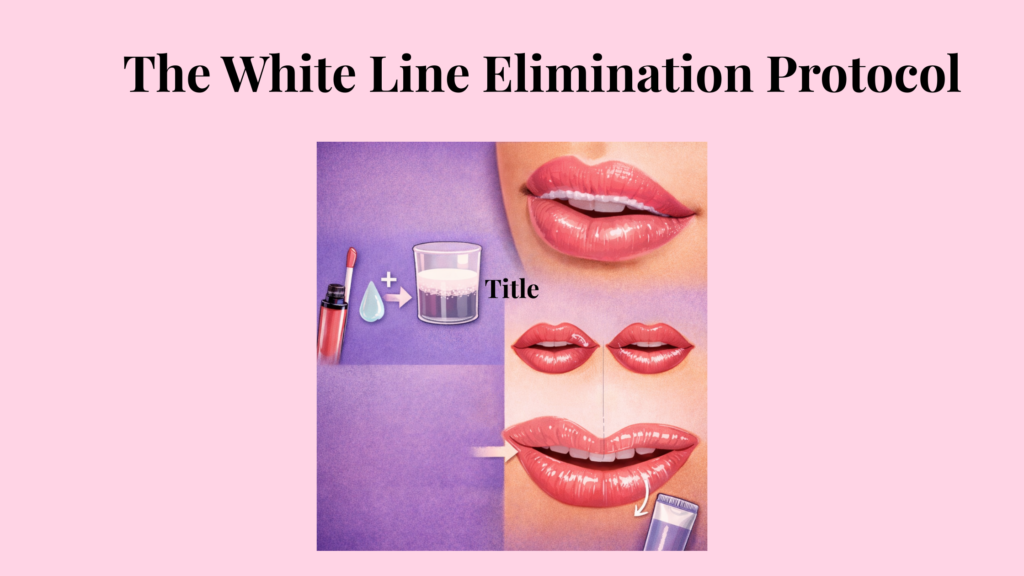
The White Line Elimination Protocol: How to Stop “Lip Gunk” Forever
The white film on your inner lip is rarely a hygiene issue; it is a scientific phenomenon called Emulsion Failure, occurring when oil-based polymers react with salivary enzymes and separate (1, 2).
It’s visceral. It’s embarrassing. You’re in a meeting, you feel that stringy tension when you open your mouth, and you know it’s there. A line of white paste. You wipe it away. It comes back. It feels like curdled milk. It looks like hygiene negligence. But it’s actually physics.
Protocol Definition
This is a 4-day diagnostic method (Heuristic Guideline) designed to isolate application technique from chemical incompatibility. By following the “Safety Zone” heuristic, you will determine if you need to adjust your placement or completely switch formula bases to stop the reaction.
STOP & REFER: Clinical Decision Boundary
Before starting the protocol, verify that what you are seeing is cosmetic residue and not a medical condition like Leukoplakia. Use this criteria checklist:
- Wipeability: Cosmetic residue wipes off cleanly. Leukoplakia cannot be wiped away.
- Texture: Residue is soft, slime-like, or stringy. Leukoplakia is often thickened, hardened, or rough.
- Persistence: Residue appears hours after application. Leukoplakia persists for weeks, even without product use.
- Sensation: Residue is annoying. Leukoplakia is often painless but can be sensitive to touch or spicy foods.
If your condition matches the medical criteria, do not scrub. Consult a specialist immediately (Safety).
This protocol helps you calculate your Efficiency Delta, distinguishing between simple user error (mechanical overload) and fundamental chemical incompatibility with your saliva.
Phase 1: Defining “Inner-Lip Emulsion Failure” (The Core Problem)
Inner-Lip Emulsion Failure occurs when the hydrophobic (water-repelling) barrier of a lip product is breached by hydrophilic (water-loving) saliva, causing the formula to curdle (3).
Most cosmetic polymers are designed to sit on dry skin. But the mouth is a hostile environment. It is a “Demilitarized Zone” where the dry vermilion border meets the wet mucosa. When you cross that border, you aren’t just wearing makeup; you are running a chemistry experiment. Lochhead (2014) notes that water-in-oil emulsions are inherently unstable when exposed to surfactants or sudden pH shifts (3).
This failure usually occurs within 2 hours (Heuristic Guideline) of application. It starts as a loss of shine. Then it becomes tacky. Finally, the “phase separation” happens—the oil separates from the pigment, leaving behind that dreaded white line.
The “Salad Dressing” Effect
Just as oil and vinegar separate without an emulsifier, your lip gloss separates when mixed with saliva.
Your mouth isn’t just full of water; it is a complex chemical bath. The primary culprit here is Salivary Amylase, an enzyme in saliva specifically designed to break down starches and complex chemical bonds. When this enzyme contacts the oil-based polymers in your gloss, it doesn’t just wet them; it actively destabilizes the formula’s structure. Combined with a pH range of 6.2–7.6, the enzyme activity forces the “curdling” effect (2). As the base separates, the pigments—which are solids—fall out of suspension and form the visible white line. It clumps. It looks gross. And it’s not your fault. It is simply enzyme activity.
Phase 2: Variable Control – Isolating the Application Zone
To solve the failure, we must isolate the Application Zone to see if the issue is positional or chemical.
The Independent Variable (The Test)
You will alternate between two application methods over a 4-day period (Heuristic Guideline).
-
Test A
Days 1 & 3: “The Full Sweep.” Apply gloss normally, all the way to the inner rim/gums (High Mucosa Contact). This is your baseline for failure.
-
Test B
Days 2 & 4: “The Safety Zone.” Apply gloss only to the outer 75% of the lip, strictly avoiding the wet mucosa. Blot the inner rim immediately after application.
Control Variables
Controls reduce the noise in your data.
Hydration: Dehydration increases salivary viscosity (making it stringy/thick), so aim for consistent water intake during the test (2). Viscous saliva accelerates the “gunk” formation by physically pulling at the polymers.
Activity: Test on days with similar amounts of talking. Friction accelerates emulsion breakdown. Don’t compare a “Netflix Sunday” to a “Presentation Monday.”
Phase 3: The Data Collection Log (Tracking Emulsion Failure)
Accurate diagnosis requires logging the “Time to Failure”—the exact minute you notice the white film forming.
*Enter your times below to calculate results automatically.*
| Day | Method | Hydration | Time Applied | Time Failed | Clean Wear Time |
|---|---|---|---|---|---|
| 1 | Full Sweep | — mins | |||
| 2 | Safety Zone | — mins | |||
| 3 | Full Sweep | — mins | |||
| 4 | Safety Zone | — mins |
Phase 4: Quantitative Analysis – Calculating Your “Efficiency Delta”
Analysis converts your log into a decision by calculating the difference in wear time between the two methods.
0 mins
Interpreting the Delta
The size of the gap determines your solution.
-
High Delta (> 60 mins): (Heuristic Guideline) The formula is fine, but you are applying it too deep. The “Safety Zone” method works for you.
Diagnosis: Positional Error. -
Low Delta (< 15 mins): (Heuristic Guideline) The placement doesn’t matter; the formula breaks down regardless. Your saliva’s chemistry is incompatible with this specific polymer blend.
Diagnosis: Chemical Incompatibility.
Phase 5: The Testable Hypothesis & Final Solution
Once you have diagnosed the cause, you can implement the permanent fix.
This is where chemistry saves us. Lochhead (2014) notes that silicone-based polymers often have higher water resistance than traditional vegetable oils, making them better for “incompatible” users (3).
Solution A: The “Safety Zone” Technique
If your Delta was high, your saliva is compatible with the product, but you must respect the Wet-Dry Border.
Action: Stop applying product to the inner rim. Blot the inner lip immediately after application. Treat the mucosa like lava. Do not touch it.
Solution B: The Formula Switch
If your Delta was low, your specific saliva pH or enzyme composition breaks down that specific oil base.
Action: Switch from an oil-based gloss (Look for: Polybutene, Castor Oil, Lanolin) to a silicone-based gloss (Look for: Dimethicone, Phenyl Trimethicone) which is chemically inert and resistant to enzymatic breakdown (3).
Key Takeaways: Mastering the White Line Protocol
The key methodological takeaways from the White Line Elimination Protocol are:
- Physics, Not Hygiene: The white line is caused by emulsion failure (oil/water separation), not dirt (1, 3).
- Test the Zone: Use the 4-Day Protocol to see if keeping product out of the mucosa solves the issue.
- Mind the Gap: Calculate your Efficiency Delta to distinguish between user error and bad chemistry.
- Switch the Base: If placement fails, switch to a silicone-based formula that resists salivary enzymes (3).
Conclusion
Inner-Lip Emulsion Failure is a solvable chemical reaction, not a necessary evil of wearing lip gloss.
Commit to the protocol. Whether the data points to “Positional Error” or “Chemical Incompatibility,” you now have the exact data needed to curate a flawless, gunk-free lip wardrobe.
Reference List
- Villa A, Woo SB. Leukoplakia—A Diagnostic and Management Algorithm. J Oral Maxillofac Surg. 2017;75(4):723–734.
- Lochhead RY. The Role of Polymers in Cosmetic Formulations. In: Barel AO, Paye M, Maibach HI, editors. Handbook of Cosmetic Science and Technology. 4th ed. CRC Press; 2014.
- Humphrey SP, Williamson RT. A review of saliva: normal composition, flow, and function. J Prosthet Dent. 2001;85(2):162-9. Available from: https://pubmed.ncbi.nlm.nih.gov/11208206/
- Lochhead RY. The Role of Polymers in Cosmetic Formulations. In: Barel AO, Paye M, Maibach HI, editors. Handbook of Cosmetic Science and Technology. 4th ed. CRC Press; 2014.