
Why Lip Gloss Applicator Type Matters for Lip Gloss Application
You wouldn’t paint a fine-detail portrait with a roller; similarly, the lip gloss applicator type dictates whether your formula glides on like glass or smears outside your lip lines.
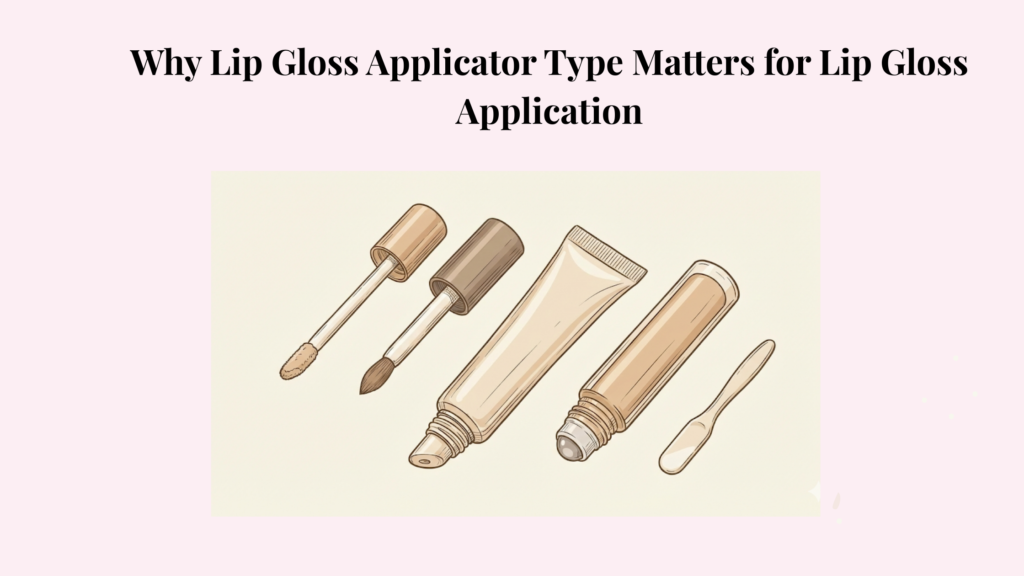
The shape, material, and flexibility of the wand control the three critical variables of application: Product Load (volume), Precision (edge control), and Texture (smoothness). It’s not just a stick; it is the interface between the chemistry and your face.
The Big Four Applicators
- 1. Doe-Foot (Sponge): Best for Sculpting. The angled sponge tip defines edges.
- 2. Brush (Bristles): Best for Floating. Lays product over lipstick without smearing.
- 3. Squeeze (Slant): Best for Hygiene. Easy to wipe clean; no double-dipping.
- 4. Rollerball (Ball): Best for Sheer Wash. Deposits a thin layer of oil.
This guide analyzes the mechanics of the “Big Four” applicators to help you match the tool to your desired finish.
Quick Guide to Lip Gloss Applicator Types
Matching the applicator to the formula is essential for achieving the intended finish without mess or waste.
The Doe-Foot: Why This Lip Gloss Applicator Type Rules Precision
The doe-foot applicator is the industry standard for precision because its flocked surface and angled tip mimic the natural curvature of the lip (1).
Draelos (2015) notes that flocking (tiny fibers) increases the surface area, allowing the wand to hold a significant “reservoir” of product while preventing drips (1). The 45-degree angle allows you to stamp the Cupid’s bow and drag the color to the corners without reloading. It acts like a lip liner and filler in one.
Key Takeaway: If you want a defined lip shape without using a separate pencil, the Doe-Foot is the only option that offers enough control.
The Brush Tip: Achieving Smoothness with this Lip Gloss Applicator Type
Brush tips are designed to “float” product onto the lips, creating a glass-like surface without the dragging friction of a sponge.
Bristles lay down a thick, unbroken layer of lacquer. Unlike a sponge which wipes/drags across the surface, a brush paints. This is critical for “Glass Skin” finishes and layering over lipstick. The lack of friction prevents the gloss from lifting or smearing the lipstick underneath.
Heuristic Guideline: Choose a brush applicator for extreme shine lacquers to avoid streaking the texture.
Squeeze Tubes and Rollerballs: Hygiene vs. Nostalgia
Non-wand applicators prioritize hygiene and speed over precision, making them ideal for on-the-go reapplication but poor for detailed work.
-
The Squeeze
A plastic angled nozzle. You can squeeze a thick bead of gel directly onto lips. No air pumping means better hygiene, but you get zero precision on the lip edge.
-
The Rollerball
A metal or plastic ball bearing. It provides a cooling sensation and deposits a microscopic thin layer (impossible to over-apply). However, they often leak or get stuck.
For a visual breakdown of these mechanics, there are 4 Lip Gloss Applicator Types that define the market.
Choosing the Right Lip Gloss Applicator Type for Your Look
The right tool depends on your desired finish, whether that is a sculpted, opaque lip or a casual wash of hydration.
| Applicator | Material | Control Level | Best Formula Match |
|---|---|---|---|
| Doe-Foot | Flocked Sponge | High (Sculpting) | Opaque / Creamy |
| Brush | Synthetic Hair | Medium (Floating) | Thick Lacquer |
| Squeeze Tip | Hard Plastic | Low (Smearing) | Thick Gel / Balm |
| Rollerball | Metal / Plastic | Low (Gliding) | Thin Oil |
Frequently Asked Questions
What is the best applicator for high-shine gloss?
A brush applicator is ideal for high-shine lacquers because the bristles float the product onto the lips without the dragging friction of a sponge, creating a smoother, glass-like finish.
Why do doe-foot applicators hold so much product?
Doe-foot applicators are covered in flocking (tiny fibers) which increases the surface area, creating a reservoir that holds liquid. This allows for “one-swipe” coverage.
Are rollerball applicators hygienic?
Rollerballs can be less hygienic than squeeze tubes but better than jars. The ball picks up bacteria from the lips and rolls it back into the liquid housing, similar to the pumping effect of a wand.
Final Thoughts on Prioritizing Applicator Type
A great formula with a terrible wand is a wasted product, as the application experience often determines whether a gloss becomes a staple or sits in the drawer.
Pro-Tip: If you love a formula but hate the applicator (e.g., a messy brush), buy disposable doe-foot wands. It creates a professional application every time without double-dipping bacteria back into the tube (Heuristic Guideline).
Reference List
- Draelos ZD. Cosmetic Dermatology: Products and Procedures. 2nd ed. Wiley-Blackwell; 2015. Available from: https://onlinelibrary.wiley.com/doi/book/10.1002/9781119036517