
Why Lip Gloss Ingredients and Safety Matter for Lip Health
You wouldn’t eat your mascara, but you inevitably ingest your gloss; because lips are a mucous membrane with no protective outer layer, lip gloss ingredients and safety are critical for minimizing systemic toxin exposure (1).
It smells like vanilla. It acts like poison. Lips absorb chemicals directly into the bloodstream because they lack the thick protective layer found on the rest of your body. We eat pounds of this stuff over a lifetime. It matters what is in it.
The Ingredient Categories
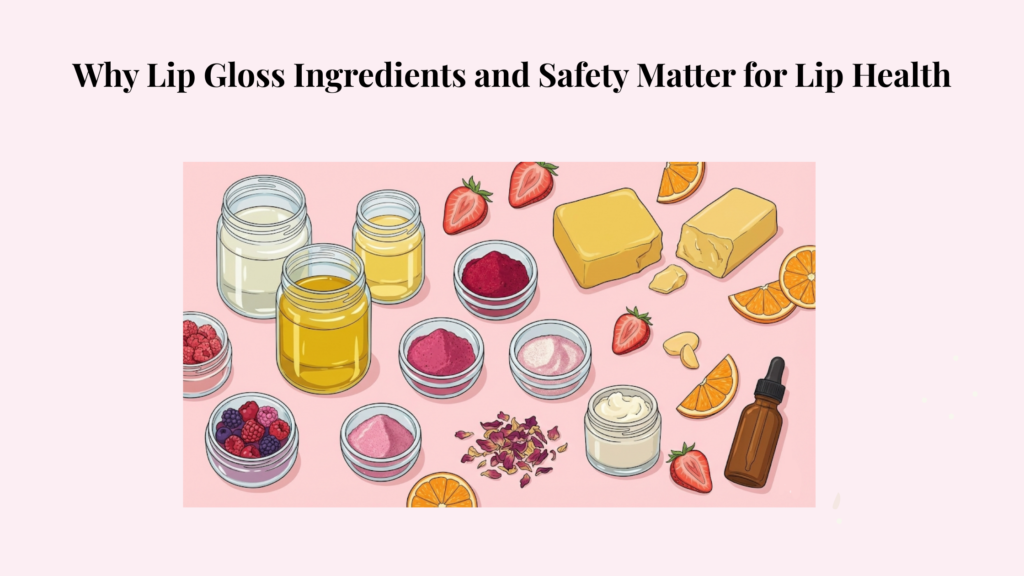
- 1. The Good (Nourish): Shea Butter, Vitamin E, Jojoba Oil. Support barrier health.
- 2. The Bad (Disrupt): Parabens, Phthalates. Linked to hormonal disruption.
- 3. The Ugly (Irritate): Menthol, Cinnamon, Capsaicum. “Plumping” agents that damage tissue.
This guide covers the “Red List” of irritants, the truth about “Clean Beauty,” and how to spot safe formulations.
Quick Guide to Lip Gloss Ingredients and Safety
A quick scan of the INCI list can instantly tell you if a product will nourish your lips or disrupt your biology.
The Biology of Absorption: Why Lip Gloss Ingredients and Safety are Critical
Lips are exceptionally permeable compared to facial skin, possessing only 3-5 cellular layers versus the standard 16, which means the barrier between the gloss and your blood vessels is microscopically thin (1).
Piccinin et al. (2023) confirm the absence of a robust stratum corneum on the vermilion border, making it a direct route for chemical absorption (1). It is a gateway.
Heuristic Guideline: Treat lip gloss like food. If you wouldn’t feel comfortable ingesting the ingredients list, don’t put it on your mouth.
Identifying Harmful Agents in Lip Gloss Ingredients and Safety
Many common additives trigger chronic inflammation, masquerading as “tingling” or “freshness” while actively damaging the collagen matrix (2).
-
Fragrance / Flavor
The #1 cause of contact dermatitis (lip rash). “Parfum” is a catch-all legal term for undisclosed chemicals.
-
Plumpers
Ingredients like peppermint, cinnamon, and bee venom work by intentionally causing inflammation (swelling). That burn is damage.
-
Preservatives
Parabens prevent mold but are known endocrine disruptors, mimicking estrogen in the body (3).
Ethical Standards in Lip Gloss Ingredients and Safety
Safety extends beyond toxicity to ethical sourcing, but labels like “Vegan” and “Cruelty-Free” are often conflated despite meaning very different things.
Carmine: The bright red pigment found in many “natural” glosses is crushed beetles (cochineal extract). “Vegan” guarantees this is absent.
Lanolin: A deeply moisturizing wax from sheep’s wool. Excellent for hydration but a common allergen for some and definitely not vegan.
Cruelty-Free: Refers to testing, not ingredients. A product can be cruelty-free but still contain toxic chemicals or animal byproducts.
Evaluating Lip Gloss Ingredients and Safety for Your Needs
This decision matrix helps you filter products based on your specific health priorities, whether that is avoiding allergens or ensuring ethical compliance.
| Ingredient Category | Safe / Beneficial Examples | Red Flags (Avoid) |
|---|---|---|
| Base / Moisture | Shea Butter, Coconut Oil | Mineral Oil (Petroleum byproduct) |
| Preservatives | Phenoxyethanol (Low dose) | Propylparaben, Butylparaben |
| Scent / Flavor | Food Grade Extracts | Synthetic “Fragrance” or “Parfum” |
| Pigment | Iron Oxides, Mica | Carmine (if Vegan), Coal Tar Dyes |
Frequently Asked Questions
Is lip gloss safe to eat?
While incidental ingestion is expected, many glosses contain ingredients like parabens or synthetic fragrances that are not meant for consumption. Always check for food-grade safety if this is a concern.
What are the most toxic ingredients in lip gloss?
Common concerns include Parabens (endocrine disruptors), Phthalates (often hidden in “fragrance”), and heavy metals found in low-quality dyes.
Does vegan lip gloss mean it is chemical-free?
No. “Vegan” only means it contains no animal products (like beeswax or carmine). A vegan gloss can still contain synthetic chemicals, preservatives, and allergens.
Conclusion
Your health is worth more than a pretty shine, and understanding the ingredient list is the only way to protect your body from unnecessary toxin load.
Pro-Tip: Download a scanner app (like Yuka or EWG) to scan lip gloss barcodes in the store for an instant safety rating before you buy (Heuristic Guideline).
Reference List
- Piccinin MA, Zito PM. Anatomy, Head and Neck, Lips. [Updated 2023]. In: StatPearls. Treasure Island (FL): StatPearls Publishing. Available from: https://www.ncbi.nlm.nih.gov/books/NBK507900/
- Deza G, Goossens A. Allergic contact cheilitis. Contact Dermatitis. 2016;74(5):279-284. Available from: https://pubmed.ncbi.nlm.nih.gov/27004653/
- Darbre PD, Harvey PW. Parabens can enable hallmarks and characteristics of cancer in human breast epithelial cells: a review of the literature with new data on their estrogenic activity. J Appl Toxicol. 2014;34(9):925-38. Available from: https://pubmed.ncbi.nlm.nih.gov/24458849/
One Response