
Why Wear Time Matters When Buying Lip Gloss: The Reality of Reapplication
We want a gloss that lasts 12 hours, but we also want it to feel like water; unfortunately, lip gloss wear time is the ultimate trade-off between duration and comfort dictated by the laws of physics (1).
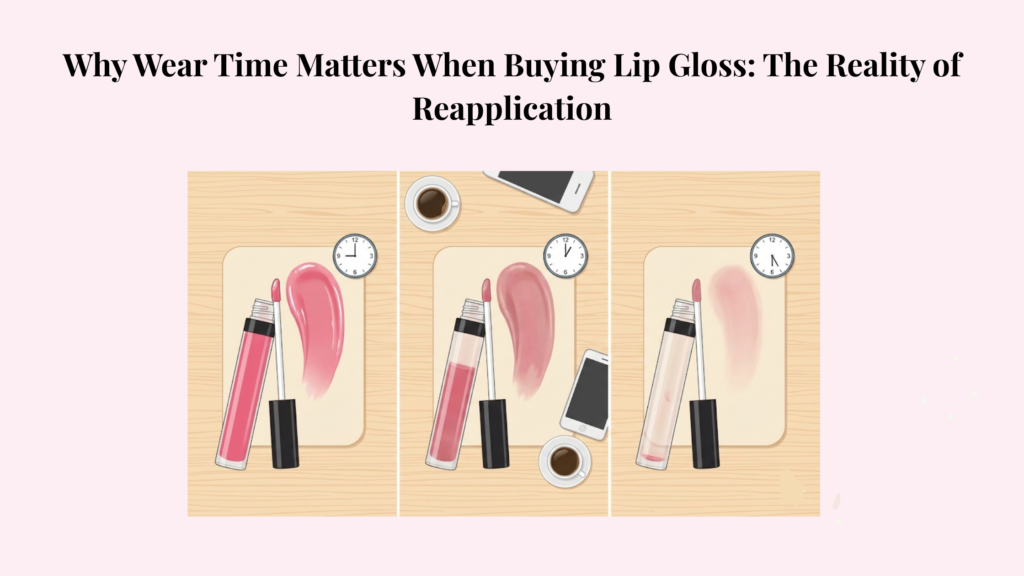
Unlike liquid lipsticks which dry down to anchor themselves, gloss remains in a liquid state. It never truly “sets.” It moves. It fades. That’s what liquids do. Acknowledging this reality is the first step to building a functional lip wardrobe.
The Longevity Tiers
- 1. Short Wear (30-60 mins): High-slip Lip Oils. Best for hydration and comfort.
- 2. Medium Wear (2-3 hours): Creamy/Balmy glosses. Best for daily office wear.
- 3. Long Wear (4+ hours): Sticky/Tacky Lacquers. Best for events where you can’t touch up.
This guide explains the chemistry of adhesion and how to choose a formula that fits your specific reapplication schedule.
Quick Guide to Lip Gloss Wear Time Expectations
Setting realistic expectations prevents buyer’s remorse, allowing you to categorize your collection by function rather than fantasy. If a brand promises “10-hour wear” for a non-sticky gloss, it is a marketing lie.
The Adhesion Factor: What Dictates Lip Gloss Wear Time?
Wear time is determined by the balance of viscosity (thickness) and tackiness (stickiness), as these properties create the physical bond needed to resist migration (2).
Draelos (2015) explains that substantivity (adherence to skin) in color cosmetics is directly proportional to the molecular weight of the polymers used (2). Heavy polymers equal high tackiness. Light oils equal low tackiness.
The Equation: High Stickiness + High Thickness = High Wear Time.
The Enemy: Friction (talking/rubbing) and Oils (from food) break the surface tension, causing the gloss to dissolve.
Matching Lip Gloss Wear Time to Your Schedule
The “best” gloss depends entirely on your access to a mirror, making your daily schedule the primary filter for product selection.
-
The Desk Gloss
(Low Wear): When you are sitting at a desk, wear time doesn’t matter. You can reapply mindlessly. Prioritize comfort (Oils).
-
The Dinner Gloss
(High Wear): When you are social and eating, you need adhesion. Real Talk: Even long-wear gloss will not survive a greasy burger (oil dissolves oil), but it will survive drinks and talking.
-
The Event Gloss
(Max Wear): Weddings/Photos. You need a lacquer that acts like “makeup superglue” and likely requires makeup remover to take off.
Using Lip Gloss Wear Time to Protect Lipstick
A gloss applied over a matte lipstick acts as a “sacrificial layer,” taking the hit from friction and cups to protect the pigment underneath.
Sethi et al. (2016) note that applying a low-viscosity oil over a structured wax (lipstick) can act as a solvent, breaking down the base layer prematurely (3). This is a critical chemistry layering error.
Key Takeaway: Avoid lip oils over matte lipstick if longevity is the goal. Use a sticky gloss (high polymer) as a topcoat instead; oils will dissolve your lipstick.
Evaluating Lip Gloss Wear Time for Your Needs
This matrix helps you trade off comfort for time, ensuring you buy the right tool for the right occasion.
| Formula Type | Estimated Wear Time | Comfort Level | Reapplication Freq |
|---|---|---|---|
| Lip Oil | 30 – 45 Mins | 10/10 (Weightless) | Constant |
| Cushion / Balm | 1 – 2 Hours | 8/10 (Soft) | After coffee |
| Vinyl / Lacquer | 3 – 5 Hours | 4/10 (Sticky) | After meals only |
Frequently Asked Questions
Can a lip gloss last all day?
No. Unlike liquid lipsticks which dry down to a solid film, lip gloss remains a viscous liquid. Physics dictates that eating, drinking, or talking will eventually move the product.
Why does my lip gloss separate on my lips?
This often happens when oils in the gloss interact with oils in your foundation or lipstick, or from the oils in food. It breaks the surface tension, causing the pigment to pool in lip lines.
Is lip oil long-wearing?
Generally, no. Lip oils prioritize penetration (absorption) and slip over adhesion. They are designed to condition the lips, not to sit on top of them for hours like a polymer-based gloss.
Final Thoughts on Realistic Lip Gloss Wear Time
Gloss is a high-maintenance category by nature, but accepting that wear time is finite allows you to stop searching for miracles and start building a functional wardrobe.
Pro-Tip: If you need longevity but hate the sticky feel, fill your entire lip with a waterproof lip liner first, then use a thin layer of medium-wear gloss. The color stays even when the shine fades (Heuristic Guideline).
Reference List
- Lochhead RY. The Role of Polymers in Cosmetic Formulations. In: Handbook of Cosmetic Science and Technology. 4th ed. CRC Press; 2014. Available from: https://www.taylorfrancis.com/books/mono/10.1201/b16716/
- Draelos ZD. Cosmetic Dermatology: Products and Procedures. 2nd ed. Wiley-Blackwell; 2015. Available from: https://onlinelibrary.wiley.com/doi/book/10.1002/9781119036517
- Sethi A, et al. Moisturizers: The Slippery Road. Indian J Dermatol. 2016;61(3):279-287. Available from: https://pubmed.ncbi.nlm.nih.gov/27293248/