
Why Lip Gloss Flavor and Scent Matter in Lip Gloss Choices
For many, the love of makeup started with a strawberry-scented rollerball, but lip gloss flavor and scent are complex chemical formulations that dictate user experience, signal active ingredients, and directly impact skin barrier health (1).
Flavor isn’t just about taste; it’s a chemical signal. When a gloss smells like mint, it feels like fire. When it smells like cloying vanilla, it triggers a headache. And when it tastes too good, it destroys your lips because you lick it off.
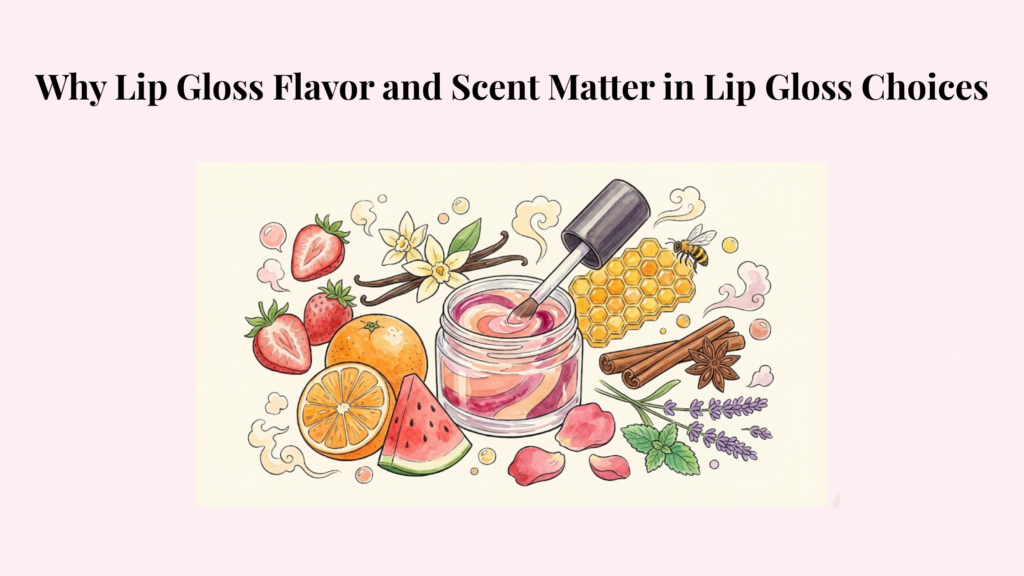
The 3 Scent Profiles
- 1. The Gourmand (Sweet/Vanilla): Comfort scents used to mask the chemical smell of wax bases.
- 2. The Botanical (Mint/Spice): Functional scents that usually signal a “Plumping” or active effect.
- 3. The Unscented (Neutral): Safety profile. Crucial for those prone to migraines or dermatitis.
This guide breaks down the psychology of “tasting” gloss, the hidden purpose of specific scents, and when to go fragrance-free.
Quick Guide to Lip Gloss Flavor and Scent Profiles
Scent profiles generally fall into three functional categories, each serving a different psychological or chemical purpose. Currently, there are 30 lip gloss flavors commonly used in the market, but they all function through the same biological mechanism.
Retro-Nasal Olfaction: How Lip Gloss Flavor and Scent Work
“Tasting” your gloss is largely a trick of the mind called retro-nasal olfaction, where scent vapors travel from the back of the mouth to the nose, creating the perception of flavor (1).
Spence (2015) details how the brain combines orthonasal (sniffing) and retro-nasal (eating) cues to construct “flavor,” meaning you aren’t tasting the gloss on your tongue so much as smelling it from the inside (1). Your tongue only tastes sweet, sour, salty, bitter, and umami. The “Cupcake” experience is purely scent.
Key Takeaway: If a gloss “tastes bad” (like crayons), it is often because the scent ingredients have oxidized (gone rancid), creating a mismatch between the visual and the smell.
Decoding Functional Lip Gloss Flavor and Scent
Certain scents act as warning labels, signaling the presence of active irritants designed to alter the lip shape.
Draelos (2011) notes that ingredients like Menthol and Cinnamaldehyde are used in plumpers specifically to induce vasodilation (swelling), and their strong scent is a byproduct of their chemical structure (2).
- Mint/Peppermint: Signals Menthol (Cooling/Plumping).
- Cinnamon/Ginger: Signals Circulatory Stimulants (Heating/Plumping).
- The Warning: If you smell these notes, expect a tingling or burning sensation. Never assume a minty scent is just for freshness; it almost always accompanies a physical reaction.
The Hidden Danger of Tasty Lip Gloss Flavor and Scent
Delicious flavors trigger a Pavlovian response to lick the lips, initiating a cycle of dehydration known as “Lip Licker’s Dermatitis” (3).
Oakley (2008) describes Lip Licker’s Dermatitis as an irritant contact dermatitis caused by the continuous wetting and drying of the skin, exacerbated by salivary enzymes (3). Saliva contains amylase, a digestive enzyme meant to break down food. When you constantly lick a tasty gloss, these enzymes break down your lip skin.
Choosing the Right Lip Gloss Flavor and Scent for You
Selecting a scent profile is a strategic decision based on your tolerance for sensory input and your skin’s barrier health.
| Scent Family | Primary Purpose | Best User Profile | Risk Factor |
|---|---|---|---|
| Vanilla / Fruit | Masking chemical base | Sensory Seekers | High Licking Risk |
| Mint / Spice | Signaling Plumping | Volume Seekers | Irritation / Stinging |
| Fragrance-Free | Safety / Hypoallergenic | Sensitive Skin | “Chemical” smell |
Frequently Asked Questions
Why does my lip gloss taste like plastic?
If your gloss is unscented or the fragrance has faded, you are smelling the raw ingredients—polymers and waxes. This “plastic” scent is the natural smell of cosmetic chemistry without a masking agent.
Does fragrance-free mean unscented?
Not always. “Unscented” products may contain masking fragrances to neutralize odors. “Fragrance-Free” means no scent ingredients were added at all. Always check the INCI list for “Parfum.”
Can lip gloss scent trigger migraines?
Yes. Strong synthetic fragrances, particularly sweet vanilla or heavy floral notes, are common migraine triggers. If you are sensitive, opt for botanical or fragrance-free options.
Conclusion
Your nose knows best; trusting your olfactory response can help you avoid allergic reactions and choose a product that creates a pleasant ritual rather than a headache.
Pro-Tip: Unscented does not always mean Fragrance-Free. Unscented products may contain masking fragrances to hide the smell of raw ingredients. Always check the INCI list for “Parfum” if you are truly allergic (Heuristic Guideline).
Reference List
- Spence C. Multisensory Flavor Perception. Cell. 2015;161(1):24-35. Available from: https://www.cell.com/cell/fulltext/S0092-8674(15)00243-9
- Draelos ZD. Cosmetic Dermatology: Products and Procedures. 1st ed. Wiley-Blackwell; 2011.
- Oakley A. Lip licker’s dermatitis. DermNet NZ. 2008. Available from: https://dermnetnz.org/topics/lip-lickers-dermatitis