
The Rebound Dryness Diagnostic Tool: Is Your Lip Gloss Drying You Out?
If your lips feel tighter or peel immediately after your lip gloss wears off, you are experiencing Reactive Desquamation, commonly known as Rebound Dryness (1).
It feels like an addiction. You apply balm, your lips feel great. An hour later, they feel drier than before, so you apply more. It peels. It burns. It feels tight. This isn’t a mental dependency; it is a physiological feedback loop. Your lips are sending a biological signal that their barrier function is failing.
Protocol Definition
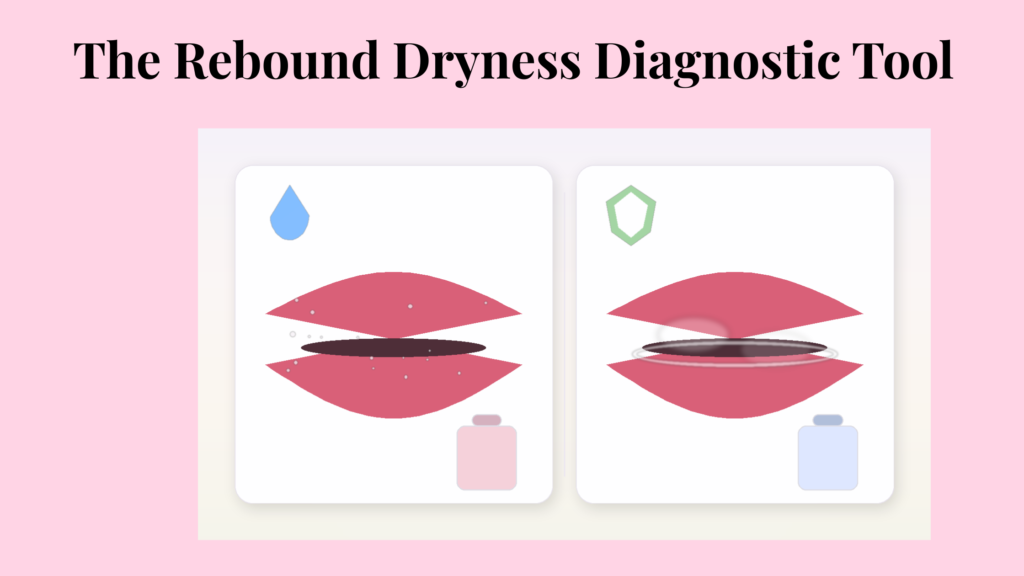
This tool is a 4-day diagnostic protocol (Heuristic Guideline) that isolates the variable of “occlusion.” By alternating application methods, we determine if the cause is TEWL (moisture loss needing a seal) or Chemical Irritation (an allergy needing a new formula).
This protocol helps you calculate your Protection Delta, distinguishing between the need for a physical shield versus the need for chemical avoidance.
Phase 1: Defining “Rebound Dryness” (Reactive Desquamation)
“Rebound Dryness” is defined here as lip texture that is significantly worse 60 minutes (Heuristic Guideline) after product removal compared to the baseline texture before application.
Why does this happen to your lips and not your cheeks? Anatomy. Piccinin et al. (2016) report that lip TEWL (Trans-Epidermal Water Loss) is 3x higher than cheek skin due to the lack of a stratum corneum and sebaceous glands (2).
Your lips are incapable of self-lubrication. They are essentially an “Evaporation Engine.” If a product supplies water (humectants) but fails to seal it in (occlusives), it acts like a sponge, pulling internal moisture to the surface where it instantly evaporates into the dry air.
Phase 2: Variable Control – Isolating the Cause of Rebound Dryness
To solve the failure, we must isolate the ‘Base Layer’ to see if the issue is a lack of seal or a toxic ingredient.
Sethi et al. (2016) demonstrate that occlusives (like petrolatum and waxes) reduce TEWL by forming a hydrophobic barrier over the skin (3). If your gloss lacks these heavy-hitters, it exposes your mucosa to the air.
The Independent Variable (The Base Layer)
You will alternate between two application methods over a 4-day period (Heuristic Guideline).
-
Test A
Days 1 & 3: “Naked Application.” Apply gloss directly to clean, bare lips. This tests the formula’s inherent barrier capability.
-
Test B
Days 2 & 4: “The Occlusive Shield.” Apply the gloss over a clear wax liner or a thin layer of petrolatum. This artificially supplies the barrier your lips lack.
Control Variables
Controls reduce the noise in your data.
Night Routine: Must use the same sleep mask/balm nightly to establish a consistent baseline recovery.
Formula: Must use the exact same gloss for all 4 days. Do not switch products mid-test.
Phase 3: The Data Collection Log (Tracking Rebound Dryness)
Accurate diagnosis requires logging the ‘Desquamation Score’ exactly 1 hour (Heuristic Guideline) after the gloss wears off.
The Symptom Scale (Heuristic Guideline)
| Day | Base Layer Strategy | Texture Score (1-10) | Notes |
|---|---|---|---|
| 1 | Naked (Test A) | ||
| 2 | Shield (Test B) | ||
| 3 | Naked (Test A) | ||
| 4 | Shield (Test B) |
Phase 4: Quantitative Analysis – Calculating the “Protection Delta”
Analysis converts your log into a decision by calculating the difference in texture scores between the two methods.
0 Points
Interpreting the Delta
The size of the gap determines your solution.
-
High Delta (> 3 points): The gloss is safe, but your application is wrong. The base layer successfully protected you.
Diagnosis: Weak Moisture Barrier (High TEWL). -
Low Delta (< 1 point): The base layer didn’t save you. The scores remain poor despite protection.
Diagnosis: Chemical Irritation (Contact Cheilitis).
Phase 5: The Testable Hypothesis & Final Solution
Once you have diagnosed the cause, you can implement the permanent fix.
Lugović-Mihić et al. (2018) identify fragrance and preservatives as top allergens in contact cheilitis, supporting the “Chemical Irritation” diagnosis when occlusion fails (4).
Solution A: Add the Barrier
If your Delta was high, your lips require a wax base to prevent evaporation.
Action: Apply a thin layer of balm or lip liner before your gloss to seal the mucosa. You need “The Shield” to keep the water inside.
Solution B: Switch the Formula
If your Delta was low, you are reacting to an ingredient in the formula itself.
Action: Discontinue use immediately. Look for fragrance-free or menthol-free alternatives to rule out contact dermatitis. The product itself is the enemy.
Key Takeaways: Solving the Rebound Dryness Mystery
The key methodological takeaways from the Rebound Dryness Diagnostic Tool are:
- Mucosal Biology: Lips cannot self-lubricate; they rely on external occlusion to prevent rapid TEWL (2).
- The Delta Rules: A high improvement with a base layer means you need occlusion. No improvement means you need a new product.
- The Goal: Cosmetic products should leave lips better (or neutral) after wear, never worse.
Conclusion
Rebound Dryness is a sign that your lip routine is physically damaging your moisture barrier.
Use the “Protection Delta” to stop guessing. Stop buying more balm to fix the problem your gloss is creating—find the root cause and eliminate it.
Reference List
- Trookman NS, et al. Immediate and Long-term Clinical Benefits of a Topical Treatment for Facial Lines and Wrinkles. J Clin Aesthet Dermatol. 2009;2(3):38-43.
- Piccinin MA, Zito PM. Anatomy, Head and Neck, Lips. [Updated 2023]. In: StatPearls. Treasure Island (FL): StatPearls Publishing. Available from: https://www.ncbi.nlm.nih.gov/books/NBK507900/
- Sethi A, et al. Moisturizers: The Slippery Road. Indian J Dermatol. 2016;61(3):279-287. Available from: https://pubmed.ncbi.nlm.nih.gov/27293248/
- Lugović-Mihić L, et al. Differential Diagnosis of Cheilitis – How to Classify Cheilitis? Acta Clin Croat. 2018;57(2):342-351. Available from: https://pubmed.ncbi.nlm.nih.gov/30431729/
One Response